
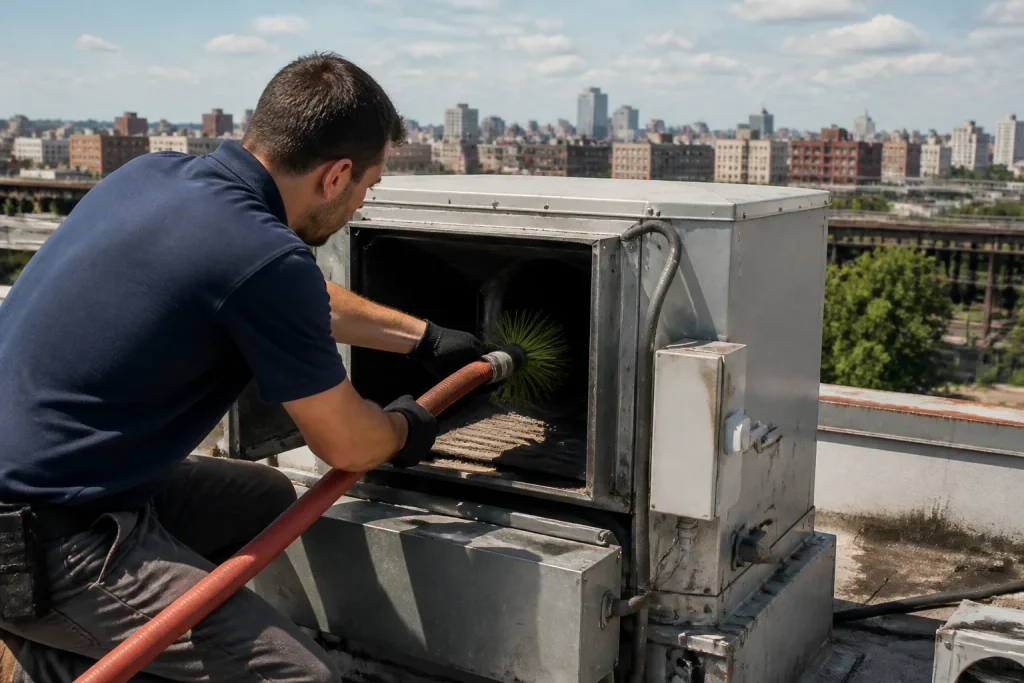
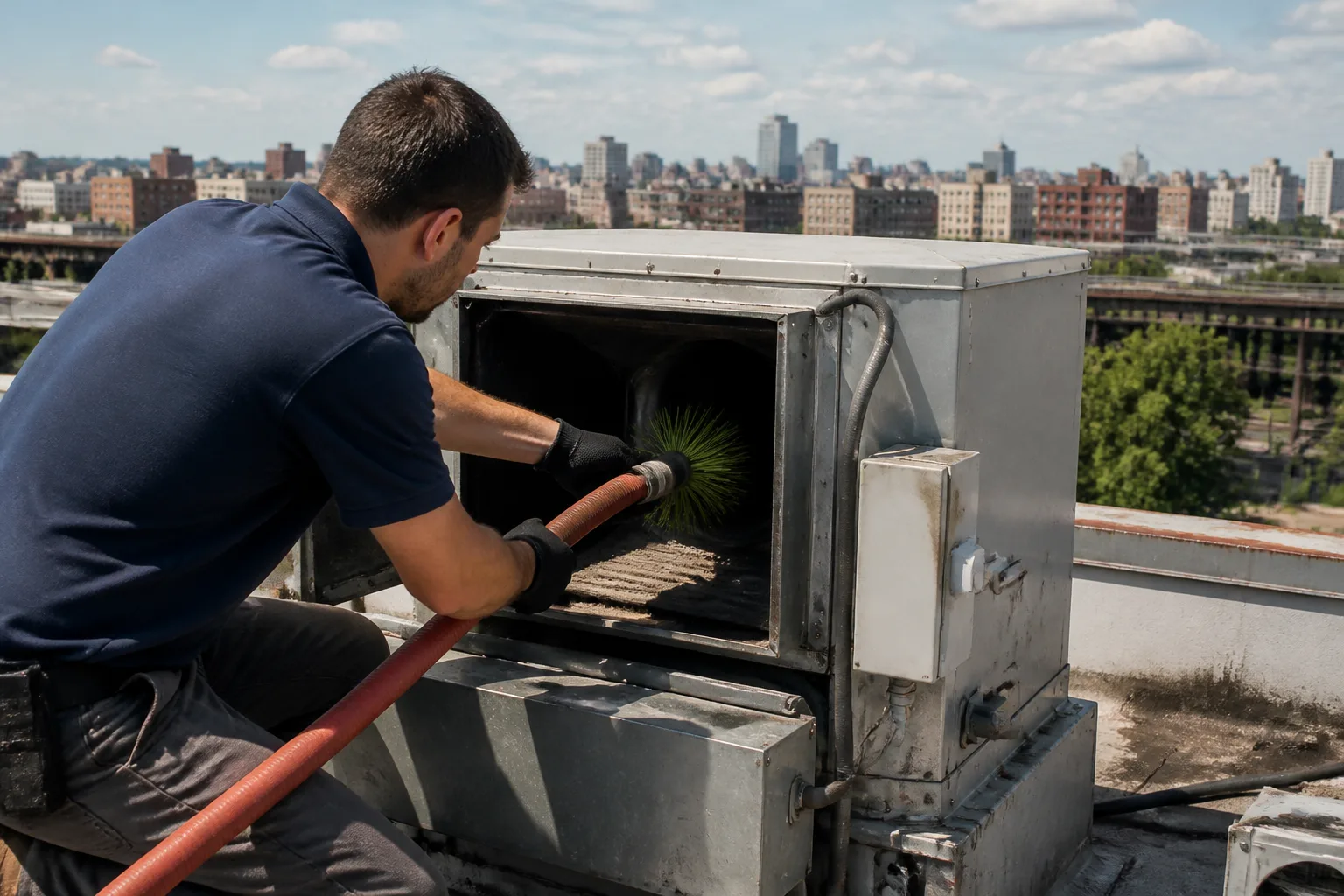
Nikro Air Duct Cleaning in Mott Haven: A Homeowner’s Guide
A Nikro air duct cleaning in Mott Haven is a duct service built around professional negative-pressure machinery, not a shop vac with a long hose. The name matters because the equipment class matters: Nikro builds the portable units, skid-mounted vacuums, and air whips that keep dust contained and pull debris toward an exhaust instead of into your rooms. If you’ve ever watched a technician wrestle a wheeled shop vacuum up a stairwell and wondered what that could possibly achieve, this guide is for you. And if you’d rather not sort through equipment claims yourself, call (855) 658-4004 and we’ll walk you through what the job actually involves.
Key Takeaways
- Nikro is a manufacturer of contractor-grade extraction equipment, and the specific tool matters less than whether the operator understands pressure.
- Negative pressure is the whole game. A portable Nikro UR500-style unit can create several hundred CFM of suction, which is powerful enough to damage weak flex duct if it isn’t balanced.
- Source removal, verified with photos and a walkthrough, separates a real clean from a surface pass.
- Mott Haven’s mix of pre-war buildings, gut-renovated rentals, and newer infill construction produces very different duct layouts, and the right method changes with the building.
What does Nikro equipment actually do inside a duct system?
Nikro builds three broad categories of tool, and each one does a different job at a mechanical level. Understanding them takes about two minutes and makes you a much harder person to sell a fake cleaning to.
Negative-pressure skid units. These are the large trailer- or truck-mounted vacuums that pull the whole duct system into negative pressure before any brushing starts. The point is directional airflow: every loose particle in the system should move toward the vacuum, not toward your bedroom. Skid units are usually paired with a HEPA exhaust filter so what comes out the other end is cleaner than what went in.
Portable vacuums. Smaller Nikro portables serve the same purpose in tight buildings where a skid can’t reach. A UR500-class unit moves enough air to collapse a compromised flex run if the operator opens a single register and pulls hard without balancing the system. A trained technician opens multiple access points and modulates suction so the duct holds its shape.
Air whips and air-sweep tools. These are compressed-air lines that snake through a duct and thrash the walls, knocking loose the dust mat that brushing alone can miss. They’re especially useful in long, straight sheet metal runs where a rotary brush can’t be steered through corners.
In our experience, the equipment is only as good as the person running the pressure settings. That’s the part most homeowners never ask about, and it’s the part that matters most in a building like the ones you find around Mott Haven.
What makes a Nikro-equipped job different from a shop-vac operation?
The difference isn’t the brand name on the vacuum. It’s the procedure that a real negative-pressure setup forces a technician to follow.
Access points. A shop-vac crew typically works through the supply registers alone, which cleans the last foot of duct and calls it a day. A Nikro-equipped job cuts or opens dedicated access ports at the plenum, at trunk transitions, and at the far ends of long runs. Those ports are sealed with proper closures when the job finishes, using Guardsman-line protective products where the duct material and condition call for it.
Pressure balancing. Real negative-pressure work means the technician is watching suction against duct integrity the whole time. Flex duct has a crush point. Sheet metal has seams that will open under too much pull. Fiberglass board will shed fibers if it’s over-agitated. Balancing pressure against the material is a skill, not a button.
Source-removal verification. The negative-pressure standard means debris is removed at the source and confirmed gone. A shop vac leaves a dust film bonded to the duct walls; a proper job leaves bare metal or clean flex liner, and you should be able to see that on camera or through a photo set.
- Ask how many access points a typical job opens. If the answer is “just the registers,” that’s a shop vac with better marketing.
- Ask where the HEPA exhaust is placed and whether it’s venting outside or into a filtered contained space.
- Ask whether the technician checks duct pressure during cleaning or just runs the vacuum full-tilt.
How should a Nikro-equipped clean look, sound, and feel while it’s happening?
You should hear a steady, low roar from the extraction unit, not the panicked whine of a shop vac begging for mercy. Beyond sound, a properly run job has a few visible signals that a homeowner or building manager in Mott Haven can check without knowing anything about HVAC.
Before the work starts. Registers get covered, floors get drop cloths, and the technician confirms which zones of the building are in scope. If there are multiple units in a Mott Haven rental building, that scope conversation should happen before anyone unpacks a tool.
During the work. The HEPA exhaust should be positioned deliberately, either venting outdoors or into a contained and filtered space, never blowing back into a hallway. The technician should be moving between access ports, not sitting on one register for an hour. Air whips make a distinct fluttering, thumping sound as they travel a duct; that’s normal and it means the tool is doing its job.
After the work. You should be shown before-and-after photos of your own ducts, not stock images from a brochure. The access ports should be closed and sealed. There should be no loose debris left at the registers. And someone should walk the system with you and explain what was found, what was cleaned, and what condition the ducts are in now.
One light note: the first few minutes of a negative-pressure job do not smell like a spa. That’s the dust leaving. It clears fast once the HEPA exhaust is running properly.
Which Mott Haven duct configurations respond best to air-washing versus contact cleaning?
Air-washing and rotary contact cleaning solve different problems, and the right call depends on what your ducts are made of and how they were installed. Mott Haven has all three common configurations in play.
Sheet metal ducts
Sheet metal takes both methods well, but air-washing is usually the faster and more thorough option on long straight runs. A rotary brush like the Rotobrush system works the walls with direct contact; an air whip reaches corners and seams the brush can’t steer into. On older Mott Haven buildings with original galvanized ductwork, we often combine the two.
Flexible duct (flex)
Flex responds best to gentle air-washing at low pressure. A rotary brush can score the inner liner, and too much negative pressure can collapse a run entirely. Flex is where the pressure-balancing question matters most, and where a technician who doesn’t understand a Nikro portable’s suction range can do real damage.
Fiberglass duct board
Fiberglass board needs the most care of all. Aggressive brushing sheds fibers, which is the opposite of what you want in an air supply. Air-washing at low pressure with filtered exhaust is usually the right method, and the technician should be honest if the board is already compromised enough that repair or replacement is the better conversation.
If you’re not sure what you have, a technician can identify the material at the first access port in about five minutes. That identification should happen before any cleaning begins, not after.
What should you ask any company claiming to use Nikro equipment?
Plenty of companies name-drop equipment brands. Fewer can answer questions about how the equipment is actually run. Here are the ones worth asking before you book a duct job in Mott Haven, or anywhere.
- What Nikro model will be on site, and what’s its airflow rating? A specific answer tells you the company knows its own equipment. A vague “the big one” tells you something too.
- Are your technicians trained on residential pressure settings? Residential systems have different tolerances than commercial. Anyone running a portable vacuum at full pull in a Mott Haven apartment is guessing.
- How many access points will you open, and how will you seal them? This is the difference between a source-removal job and a surface pass.
- Where will the HEPA exhaust go? Outdoors or a contained filtered space. Never back into your living room.
- Will I see before-and-after photos of my own ducts? If the answer is anything other than a clear yes, keep asking.
- What other equipment is on the truck? A company that also brings Abatement Technologies gear for fine-particulate and microbial work, and knows Honeywell and Aprilaire systems well enough to work with your existing filtration, is set up for the whole job, not half of it.
One contractor, full system is the standard to hold any company to. If they can clean but can’t repair and seal an access port, or can brush a duct but can’t address a filtration platform you already own, you’re going to be explaining your building to a second company a month later.
When to call a pro (and a related note on dryer vents)
Some duct conditions are worth a phone call rather than a weekend of research. If you’re seeing visible dust streaking out of registers, if a room never seems to get clean no matter how often you change the filter, if you’ve just moved into a Mott Haven building with unknown duct history, or if you’ve noticed musty odor in the return air, those are all signs that a professional assessment beats a guess. Mold and microbial concerns in particular call for proper containment and remediation-grade tools like Abatement Technologies equipment, not a household vacuum.
One related service worth pairing with a duct cleaning: if you have a dryer, the vent behind it is a separate fire-safety system, and it deserves the same professional attention. Our dryer vent cleaning is a good place to start if you’re already scheduling air quality work. If your heating and cooling equipment itself needs cleaning beyond the ducts, that’s our HVAC cleaning service.
The Bottom Line
Nikro equipment matters because negative pressure and source removal matter, and the machinery is what makes both possible. If a company shows up in Mott Haven with a shop vac and a brush, you’re paying for a surface pass. If they show up with a real extraction setup, they open access ports, balance pressure against your duct material, position HEPA exhaust deliberately, and show you before-and-after photos of your own system. Our technicians have up to 13 years of experience working with Rotobrush rotary-brush cleaning, Nikro negative-pressure extraction, and the full scope of duct repair and sealing that a complete job requires. If you’re in Mott Haven and need help, Air Duct Cleaning Mott Haven offers free estimates – call (855) 658-4004. We answer 24/7, with fast dispatch from 7am to 7pm, Sunday through Friday.
Frequently Asked Questions
Nikro air duct cleaning is duct cleaning performed with Nikro-manufactured negative-pressure vacuums, skid units, and air-whip tools. The equipment pulls the whole system into negative pressure so debris moves toward a filtered exhaust rather than into your rooms, and air whips break up dust mat that brushing alone can miss. It’s a professional-grade method, not a consumer product. Call (855) 658-4004 for an exact quote – estimates are free.
You should be shown before-and-after photos of your own ducts, and someone should walk the system with you at the end. Access ports should be closed and sealed, registers should be free of loose debris, and the technician should be able to explain what condition your duct material was in and what was cleaned. If any of that is missing, the clean wasn’t verified. Call (855) 658-4004 if you want a second opinion on a prior job.
Cheaper quotes usually reflect a shop-vac-and-register pass rather than real negative-pressure extraction with dedicated access ports. That’s a different scope of work, and it leaves the bonded dust film on the duct walls. The honest comparison is whole-system scope against whole-system scope, not a headline number. Call (855) 658-4004 for a scope you can actually compare line by line – estimates are free.
Most homes go several years between cleanings, and there’s no universal rule that fits every building. Recent renovation, visible dust at the registers, musty return air, or moving into a building with unknown duct history are the signals that matter more than a calendar. In Mott Haven, the age and renovation history of your building is a better guide than a fixed schedule. Call (855) 658-4004 and we’ll help you think through whether your system is due.
Yes. We work with Honeywell and Aprilaire platforms, which cover most residential and light-commercial filtration setups, and we use Guardsman-line protective products in air quality and sanitizing treatments. A cleaning that ignores your existing filtration equipment isn’t a complete job. Call (855) 658-4004 to talk through your system.
Written by the team at Air Duct Cleaning Mott Haven.
Need Air Duct Cleaning Help?
Call Air Duct Cleaning Mott Haven - the local pro we connect you with is licensed and insured, with free written estimates in Mott Haven.
(855) 658-4004